
The Hungry Gap
what to eat when there's not much ready in the garden.


For people who feed themselves from their gardens, this time of year has traditionally been called “the hungry gap”: late spring, when all the potatoes have been eaten and there is little fresh stuff growing yet in the garden. I have eaten all my potatoes, both the Solanum tuberosum types and the sweet potatoes, but I have a lot of winter squash and pumpkin left. And there actually are green and growing and delicious things in my garden right now, and that’s what this post is about.
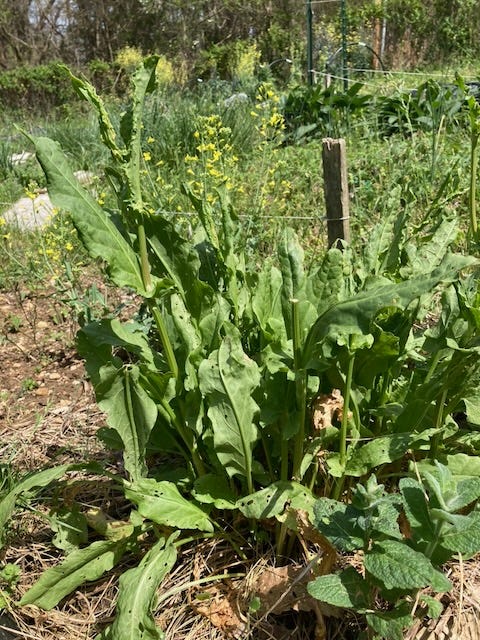
Perennial vegetables are great for solving this problem. My favorite perennial vegetable is sorrel. I can’t remember where I got the seeds from initially, because I’ve had these perennial plants for a long time. The plants start growing big and bushy in early spring, and you eat the long, strappy-looking leaves. They have a lemony tang to them and cook instantly. I just add them to soup, especially potato soup, at the end of cooking. They turn a sort of olive green, which is not beautiful, but that’s ok. You can also eat them raw in salads.
I do have some asparagus plants, but I’ve only seen two asparagus spears so far.
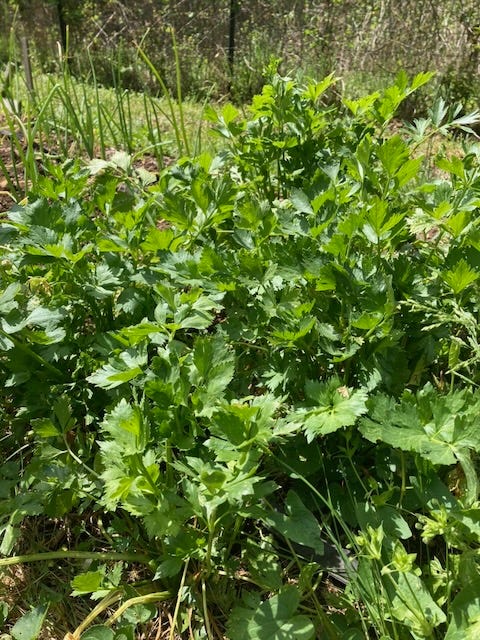
There are some biennial plants that overwinter easily in the garden and that provide abundant greens just when you want something green and fresh. One of my favorites is leaf celery, or seasoning celery. These are easy to grow in spring from the tiny seeds, although they may take some time to germinate. I start them inside under lights. Unlike “regular” celery, the plants don’t require any especially large amount of water or fertilizer. And they are surprisingly hardy! I cover mine with spunbonded row cover in winter. Simply laying it on top with no hoops seems to work fine. Then in spring, it starts growing again vigorously and you can harvest large handfuls of it. I throw these large handfuls in the soup pot, like the sorrel. Or in a pot of rice or beans.
Later in the early summer, these celery plants will bolt and produce big heads of flowers that beneficial insects love. I grow them for that reason too. After that, you can collect a lot of celery seeds. Parsley is also a great plant for beneficial insects, but recently the parsley plants have not been surviving the winter for some reason.
Supposedly one reason for the “hungry gap” period is that the kale and collard plants are now bolting to seed. True, but so what? I still pick the lower leaves off and eat them. They are fine. I also eat some of the seed stalks before they flower, or even while they are flowering. They are sort of like broccoli. You won’t need all those seed stalks in order to gather some seed later.
There are two varieties of kale that I like to plant in early spring because they grow so fast that you can start harvesting from new, young plants within a few weeks: these are ‘Madeley’ and ‘Hungry Gap.’ They seem to be the same variety to me. I start them under lights in February and transplant them with the cabbages in March. Some of those plants are ready to start picking, almost. Pick the bottom leaves and leave at least eight leaves on the plant. As they say at Adaptive Seeds, ‘Madeley’ produces “a ridiculous amount of food.” And it does so very fast.
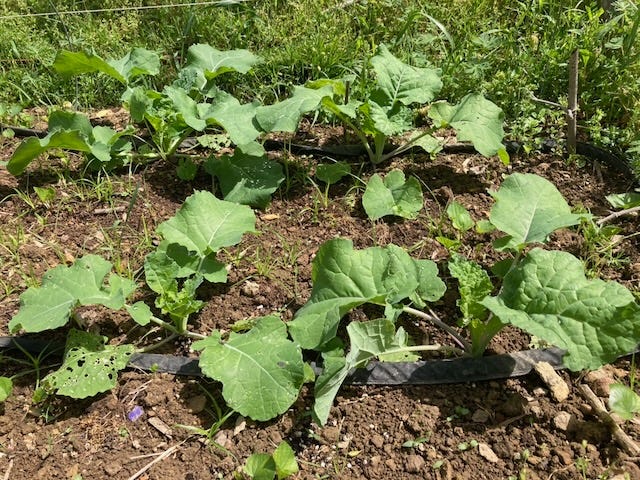
The other one is literally called ‘Hungry Gap,’ and I got it from a British seed company years ago, probably Chiltern Seeds. They don’t seem to sell it any more, but I found it here. (Adaptive Seeds also has one called ‘Russian Hunger Gap,’ but it appears to be a napus type, and I haven’t tried it.) The one I got from England looked like ‘Madeley’ and may have been the same variety. It seems that in the UK they sow this one in late summer or fall and start harvesting in spring. We could do that here too, and it may bolt a little later than regular brassicas, but I start it in spring so that it DOES NOT bolt with the others. (Bolting is triggered by the low temperatures that the plant experiences over the winter.) It grows faster than the other kales and collards.
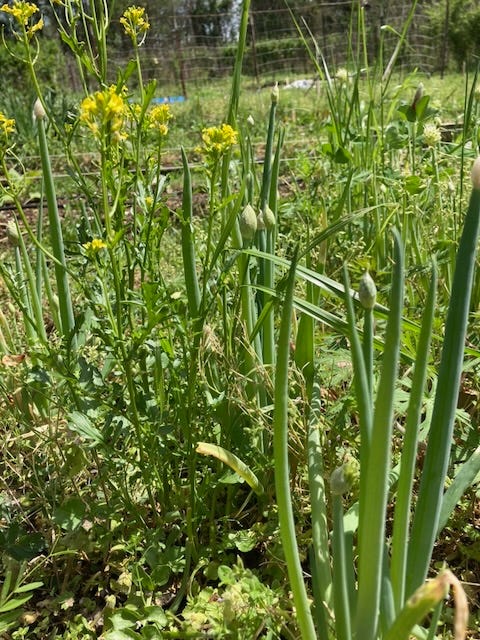
I also wintered over some bunching onions. These are surprisingly easy to grow and very handy to have when all your regular bulbing onions are gone. I started the bunching onions (‘Yago’) in late summer in containers, six to eight seeds per module. They grew under lights until probably late September, when I set them out. I didn’t separate the plants in the module: they grow great in bunches of anywhere from four to eight plants. When it got cold, I covered the bed with Agribon supported with wire hoops. (Onions do suffer if you lay Agribon directly on them; their leaves break under the weight of wet Agribon and especially snow or ice on Agribon.) Right now, they have sent up seed stalks with little flowers on the top, but I’m eating the whole thing, flowers and all. It’s easy to go out with a little hand spade and dig up one of the bunches for a meal, and just leave the rest to stay in the garden.
The only thing I planted in 2026 that is ready to eat right now is spinach: I have been pulling and eating the thinnings of some spinach rows I planted six weeks or so ago.
So, now suppose you have a big old butternut, some sorrel, some bunching onions, some celery and some spinach. Can you make a meal with that? Yes!
Most days, I make some sort of soup with that: I cut up the butternut squash, sometimes without even peeling it. Maybe I brown it a little in some olive oil. I trim the bunching onions and cut them with scissors into the pot. If I have a can of tomatoes, I add that. Maybe there are some cooked black beans or uncooked lentils: add those. When the squash is tender enough to poke with a fork, I add the celery, sorrel, and/or spinach. Those things really don’t need to cook: they just wilt immediately in the hot soup. Sometimes I add some meatballs near the end too. Obviously various herbs and spices are good in this. The Indian way with butternut and tomatoes is great: add some ginger and cumin, and maybe turmeric, to go in that direction.
But there’s another way: the “tray bake” way as British people say. But I don’t use a tray: I use a cast iron dutch oven. The key here is plentiful olive oil: I put a lot of it in the bottom of the pot, add the cut-up pieces of squash, then the cut-up onions, and whatever else. Maybe some of the celery. Pour more olive oil over it and maybe put a couple of meatballs in there. Put it in the oven, uncovered, at 350 for say thirty to forty minutes. Also a lot of salt.
I think it’s amazing that we can get really good, really affordable olive oil now. I like Terra Delyssa a lot and I use it very liberally.
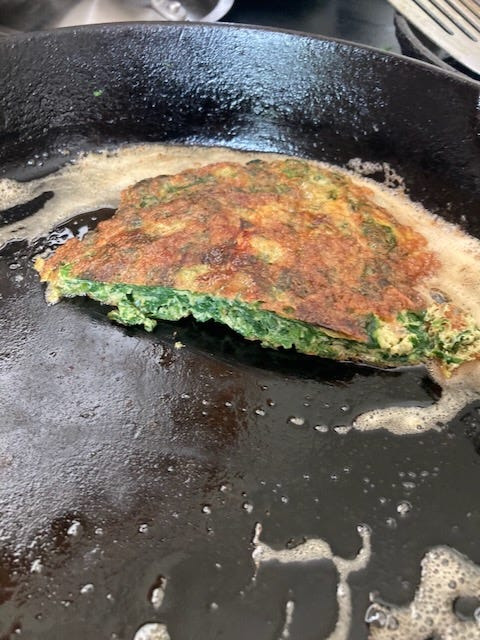
Today I made a meal with all the green stuff in the garden, plus some eggs. You may have a lot of eggs yourself: it’s that time of year. I learned this recipe from Samin Nosrat’s book, Salt Fat Acid Heat. Samin is an Iranian-American chef, and this recipe is a traditional Persian one called kuku sabzi. It’s a very greens-forward frittata. You gather up as many herbs, onions, leeks, and greens as you can find in the garden, and you cook them in olive oil and/or butter until they are wilted, maybe four to five minutes. Tip them out of the skillet into a bowl, and add enough eggs to hold the mess together. (If you start with two cups of chopped herbs and greens, you’ll need about two eggs.) Wipe out the skillet and heat it again with some butter and/or olive oil. Pour the herb and egg mixture into the skillet. Let it gently fry for ten minutes, and then either flip it like a big pancake, or put it in the oven at 350. Either way, let it cook another ten minutes either on the top of the stove in a skillet or in the oven. If you can’t eat the whole thing, don’t worry: it’s good cold the next day.
It may seem boring to just cook with the same vegetables every day, but really, the soup or “tray bake” turns out different each time. Probably this is how most people ate throughout most of history: you might eat a LOT of potatoes for months, then a LOT of pumpkins for a few more months, before you started in on your stash of dried corn or beans. Oops. I forgot: I have a lot of dried corn left still. I’ve been grinding it for cornmeal and making cornbread, but maybe I should make some hominy to put in the soup. Just to make it a little different.
Yes, I know about poke greens. I saw some poking up yesterday. I used to eat it. But you have to boil it several times to make it not poisonous. How does it poison you? Well, reader, you get bad diarrhea. Not worth it IMHO. But go on with your bad self if you want to!