
Onions in progress
since October

Recently I realized that I was starting onions under lights too late: I was starting them in late winter. Really you should start them in the fall before the year that you want to eat them. In Texas where I gardened for a few years, there was a kind of onion called 1015 onions that you started on October 15, but somehow I didn’t figure out that that also applies to some other varieties like ‘Candy’ onions. These are my favorite onions, as they get pretty big, and they last in storage pretty well for an intermediate day onion.
About that intermediate-day thing: intermediate-day onions initiate bulb development when day length is 12-14 hours. Short-day onions like 1015 start growing their bulbs when days are 10-12 hours long, and long-day onions need days of 14-16 hours to start making bulbs. These long day onions in general store better than the intermediate and short day onions, but they grow best at more northern latitudes than ours in TN. We grow intermediate day onions here, but the down side is that they are not great storage onions. ‘Candy’ is a pretty good storage onion, but after about six months in storage some of them start to sprout.
In Putnam County, we don’t have 14 hour days until late May or early June, and by then it is hot and maybe dry in our county. Onions don’t like hot dry weather. So trying to grow long-day onions doesn’t work as well for us as it does for growers in New England or the upper Midwest. Maybe some day somebody will breed a good storage onion for intermediate-day growers, but for now we have to be satisfied with a good-tasting onion like ‘Candy’ that lasts about six months in storage.
The goal with onions is to have a strong plant growing in the garden by the time the plant starts growing its bulb. For us, that period begins in late March, at the equinox. Late spring is prime growing time for onions: you want them to grow fast and make good bulbs between the equinox and the summer solstice in late June. An onion plant should have 8-12 true leaves when it starts growing its bulb.
In the past I set out relatively small seedlings in early March that I had started under lights in January, so the seedlings might be 8 weeks old. Sometimes they didn’t grow fast enough to support a big bulb. This past fall, I had a lot of ‘Candy’ seeds left over from my 2024 seed order, and I thought, “What the heck. I’ll just plant these in little trays under lights and see what happens. They might be kind of old seeds, but let’s see if they come up.” They did! Then I just kept watering them.
They grew strongly, until finally I had to pot them up to four inch pots, usually four plants per pot. I decided to grow 100 sq ft of onions, so I needed 200 plants at six inches apart in rows twelve inches apart. (There were some leftover seedlings and I just potted up clumps of the smaller leftover seedlings into the four inch pots as well. They can be bunching onions for an early harvest.)
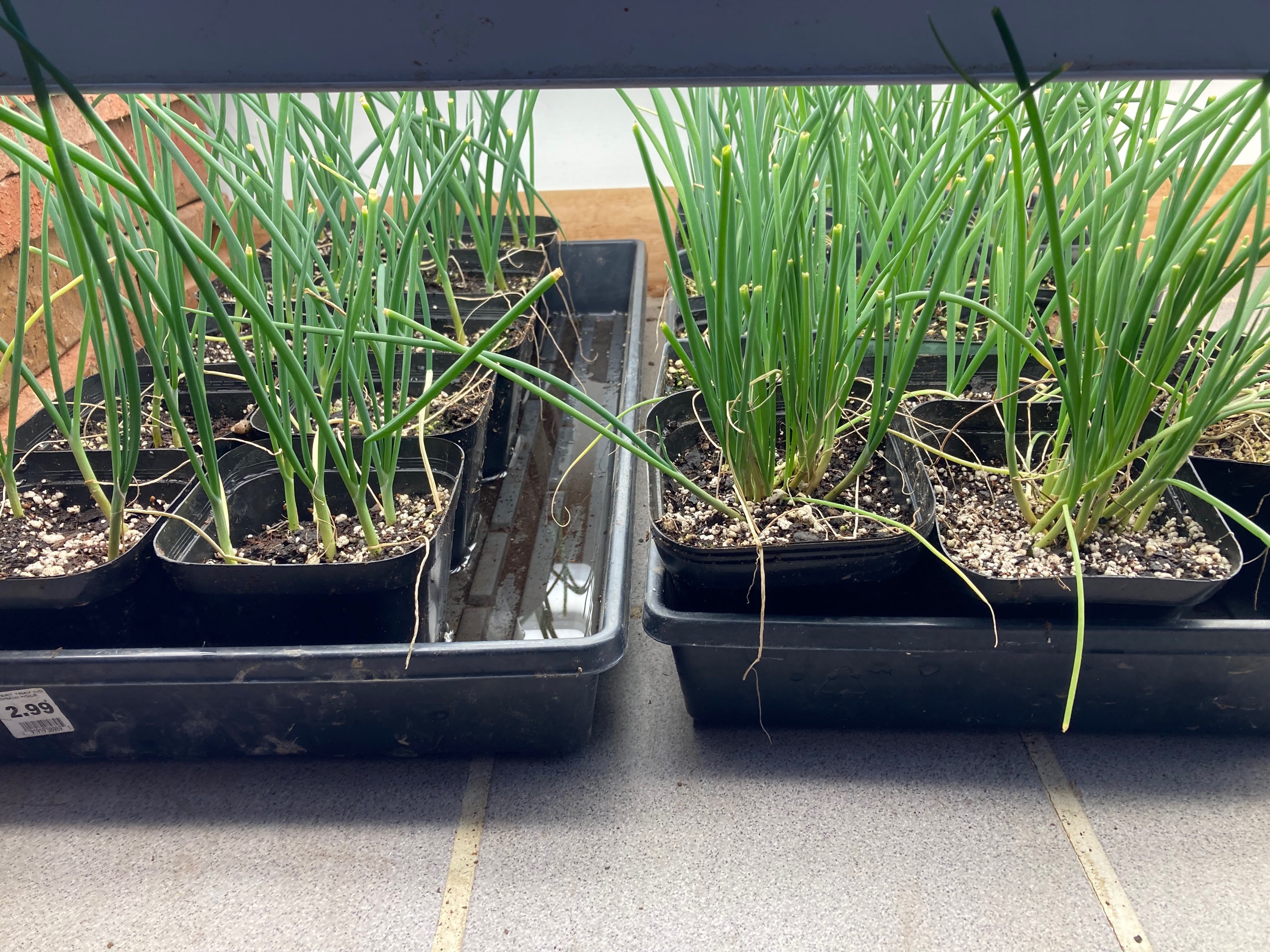
One problem with growing onions under lights is that they get pretty tall. But I found out you can simply trim the tops back to about four inches without hurting them. When I have bought onion seedlings by mail order, they arrive as clipped seedlings about four inches long, somewhat dried up, but still alive. This is definitely a viable option if you don’t want to grow them under lights all winter. They come back to life as soon as you transplant them into the garden.
I can tell already that these seedlings that have been growing under lights since October are going to take off much faster than the wimpy ones I grew last year. I expect I will get bigger bulbs this summer.
I had to get some new lights, though. In the past I used four foot long shop lights, fluorescent fixtures with replaceable fluorescent bulbs, but some of those fixtures were dead this time when I turned them on. The new shop lights have built-in LED bulbs that are not removable, but that’s ok: they don’t contain hazardous materials like the old fluorescent bulbs that had to be carefully recycled. They also seem brighter. I simply lay the shop lights on top of bricks and add more bricks as the plants grow.
Soon I will start moving the plants outside to the deck where they will get even more light and can “harden off” prior to being planted in the garden. Onion seedlings can take some temperatures below 32, but tender seedlings that have been inside for months need to be exposed gradually to cold temperatures. After about a week of being outside, they can tolerate temperatures down to 28 degrees. But don’t let them dry out, especially if they are in small cells.
What to do with the onions that are sprouting now? Some of the ones sprouting now are red onions, ‘Red Rock.' I grew these in 2025, and most of them are now sprouting. As an experiment, I transplanted some of these sprouting onions to the garden under some spun-bonded row cover. If things go well, they will survive any cold weather and continue growing and perhaps even divide, as a friend says happened in his garden, making a cluster of small red onions for 2026 from each 2025 red onion.
The ‘Candy’ onions are also beginning to sprout. You can definitely eat the green sprouts, but sometimes the onion bulb itself is soft and a bit rotten looking. Sometimes you can peel off the exterior soft layers and find a hard bit inside to chop up and eat.
I know that organic onions in the grocery store are pretty affordable and that in some ways it does not make a lot of sense to grow your own onion seedlings under lights for months. But it’s sort of interesting and fun, and these seedlings are way better than onion sets or those bundles of dried-up seedlings you can buy in spring. Then there’s the later challenge of drying the onions after harvest so that they will store. I am getting better at that and will write about that more when the time comes to do it.