
New Potatoes!
and how to eat them

Well, you probably know the fastest and best way to eat them: boil them, drain them, then put a lot of butter on them and kind of mash them up a little. Just eat it right out of the pot you cooked and mashed them in. (I’m not the only old lady who eats food right out of the cooking pot; another old lady told me she does the same thing. People do it while camping; why not at home?)
For some variation, you could cook some collard or kale leaves in the same pot with the potatoes, drain the whole mess after twenty minutes or so, and then add the butter, and this time some sour cream, and then mash. While they’re cooking you could sauté an onion to pour over it. Now you’re making colcannon, which comes up on cooking blogs around Halloween, but there’s no reason you can’t make it now.
(Apparently at Halloween, at least in Ireland, you’re supposed to hide some kind of little coin or thimble in it and whoever gets that in their mouth gets a wish. It’s sort of like the plastic baby that goes in a King Cake in New Orleans. I don’t think it’s a great idea to hide choking hazards in food though, so I don’t do it.)
Moving on. I’m also into potato salads because like cole slaw, they can be made ahead and kept in the fridge for when you’re hungry, or taken to other people’s houses cold. There are basically two kinds, as far as I can tell: the mayonnaise kind and the oil and vinegar kind. The second kind is less well known in the United States but it’s pretty standard in Europe. I like the mayonnaise kind quite a lot. My favorite mayonnaise potato salad recipe is the one on the Smitten Kitchen site: Rosanne Cash’s potato salad. It apparently first appeared in an article written by Rosanne Cash on the Epicurious site in 2004 and went sort of viral.
On the Smitten Kitchen site, Deb gives some helpful hints about how to slice the potatoes without having them fall apart: cook unpeeled, whole potatoes until fork-tender, and then refrigerate them overnight! This really does make a big difference when trying to slice them, and I recommend it.
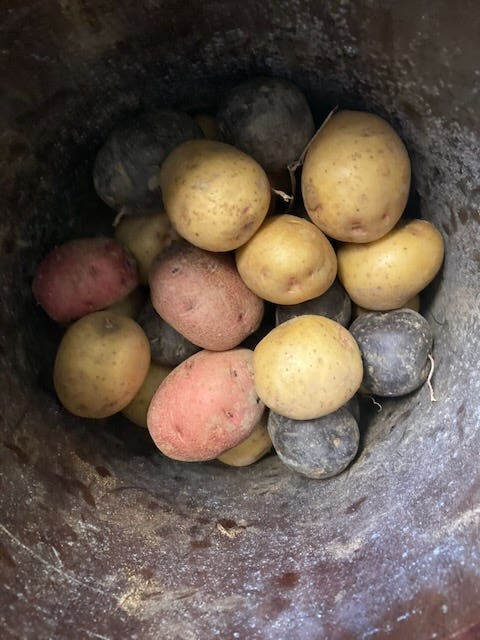
The other kind—the oil and vinegar kind—is the type that is in Mastering the Art of French Cooking, The Victory Garden Cookbook, and a lot of Ottolenghi recipes. In a way it’s much simpler: you pour a vinaigrette sauce (oil, vinegar, salt, and mustard) over the warm, sliced potatoes shortly after cooking them. That’s it. No pickles, no hard-boiled eggs, no celery. (Mayonnaise is allowed though if you want, according to Julia, but I don’t think it’s indicated.) It’s very good immediately, but it can also be chilled and served later with cold green beans and other things in Salad Niçoise. I had some of this warm potato salad for breakfast this morning, made with new Yukon Gold potatoes and some blue potatoes. ‘Yukon Gold’ is one of the easiest potatoes to grow, and it is ready earlier than ‘Kennebec’ or ‘Red Pontiac.’ The blue potatoes are an unknown variety that I found in a grocery store.
I have found that it’s a bit hard to slice warm potatoes without them falling apart if they’re too tender, so it’s good to undercook them just a little. Since they may not all be the same size, you have to keep checking. These two to three inch diameter potatoes take about 20 minutes, so I start checking at about 15 minutes with a little paring knife. I poke them to see if there’s any resistance and remove them right when the middle is done and not later. Also they may continue cooking while they cool for a few minutes after draining them and before slicing.
About the vinaigrette sauce: I just make the one in Mastering, which is three parts olive oil to one part vinegar, some salt, and some mustard. I shake it up in a little jar.
I may have written about this next way to eat potatoes before because I love it so much, but here goes again: it is the first recipe in Mastering vol 1, and it is potage parmentier, otherwise known as leek and potato soup. It’s barely a recipe: equal parts (by volume) chopped leeks and potatoes, water, and salt, boiled till soft, then mashed or blended. I had it for breakfast this morning. At the end you can add some cream or milk and some herbs.
It’s interesting that the word for leek in French, poireau, is apparently related to the English word porridge. I thought that porridge had to be oats or something, but it’s ok to make porridge with leeks and vegetables and to have it for breakfast. Maybe potage parmentier is the original porridge.
One time I was visiting at a neighbor’s house. Their grandchildren and adult children were visiting, and nobody could decide what to do about supper: go out to eat? Look around in the fridge? A kind of paralysis set in. I asked if there were onions, potatoes, and milk. They said yes. I made potage parmentier (because you can use onions in a pinch.) Everybody ate it. Ms Pat (the grandmother) said, “Why is this soup so good?”
And I said, “Because I’ve made it every night for the last few weeks or so.”
The great thing about leek and potato soup is that the leeks and potatoes are just the beginning. It will absorb almost anything you have in the garden or in the refrigerator. Julia says that in the beginning, before you purée it, you can add some carrots or turnips, some tomatoes, and some half cooked dried beans or peas. But after you purée it, you can still add things and simmer the purée for ten or fifteen minutes with these things in it: fresh cauliflower, cucumbers, broccoli, lima beans, peas, string beans, okra, zucchini, shredded lettuce, spinach, sorrel, or cabbage.
Then at the very end, you can add cooked leftovers of any of these vegetables, and tomatoes. I add some herbs at the end usually, like parsley. And I like to add a lot of cream or sour cream. Apparently if you eat this mess cold, it’s called vichyssoise. It has a French-sounding name, but it was invented at a hotel in New York City. Here’s an entertaining article from a 1950 New Yorker magazine about the French chef who invented vichyssoise in 1917, before his home town of Vichy was associated with people who collaborated with Nazis. He even mentions the “Boches,” you know, those cabbage heads who invaded France.
That reminds me: there used to be a toy called Mr Potato Head that used real potatoes, not a plastic one, to make a “funny face.” That was in the 1950s, a decade some of us can remember. But then, sadly, the real potato head was replaced by a plastic head! People, this is just not as good. Selecting a real potato and poking the plastic face part prongs into the raw potato in inappropriate ways was what made it fun. You had to destroy the potato in order to save it. The plastic potato is just not the same.
I found out why this “improvement” was made though: kids were leaving pierced and rotting funny face potatoes under their beds sometimes, and eventually these mangled potatoes began to smell bad. The mothers probably objected.
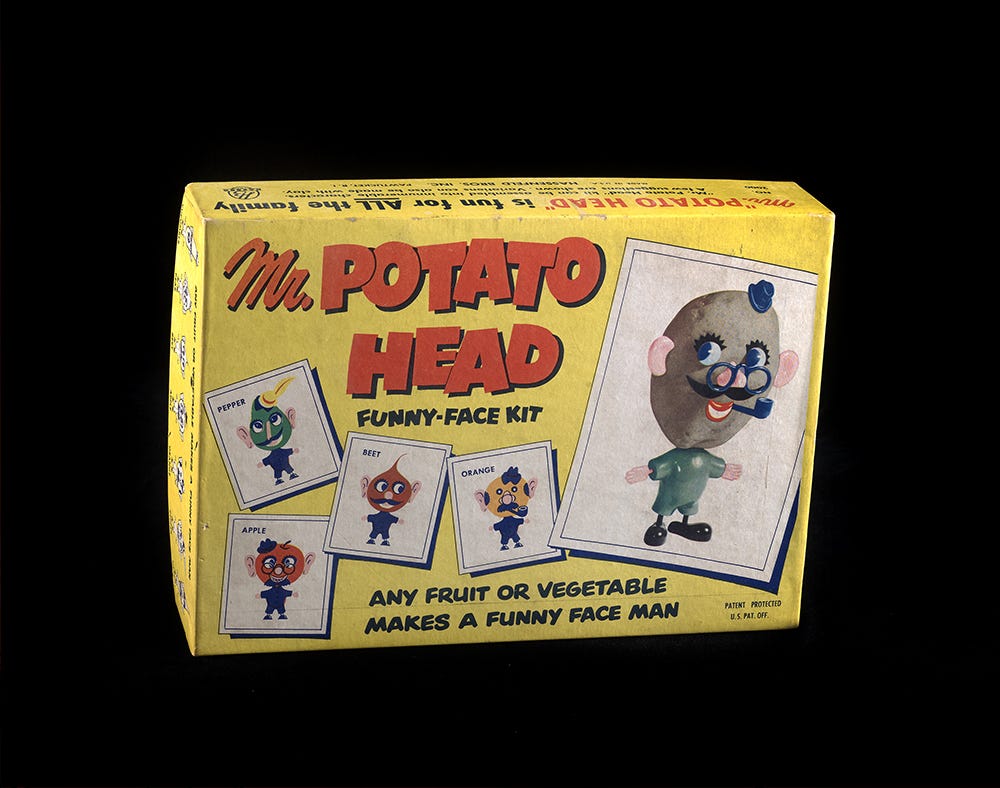
There was also Mrs. Potato Head, but we didn’t have one of those. Apparently all female potatoes are married, or it was thought that unmarried female potatoes were not appropriate toys for children. But a doll based on a German sex worker named Barbie was fine. Now you know why Boomers are weird.
Go forth and eat your new potatoes!
Also, it never hurts, as a motivation, to read some stuff about gardening. I found this quote in my Readwise daily email this morning, and it made me proud to be in a long tradition of gardeners going back to the Neolithic.
“What if we shifted the emphasis away from agriculture and domestication to, say, botany or even gardening? At once we find ourselves closer to the realities of Neolithic ecology, which seem little concerned with taming wild nature or squeezing as many calories as possible from a handful of seed grasses. What it really seems to have been about was creating garden plots—artificial, often temporary habitats—in which the ecological scales were tipped in favor of certain species.”—David Graeber, The Dawn of Everything
It’s ok if your garden is a messy habitat only temporarily tipped in favor of potatoes and some other plants.