
harlequin bugs
And the Purple Project continues

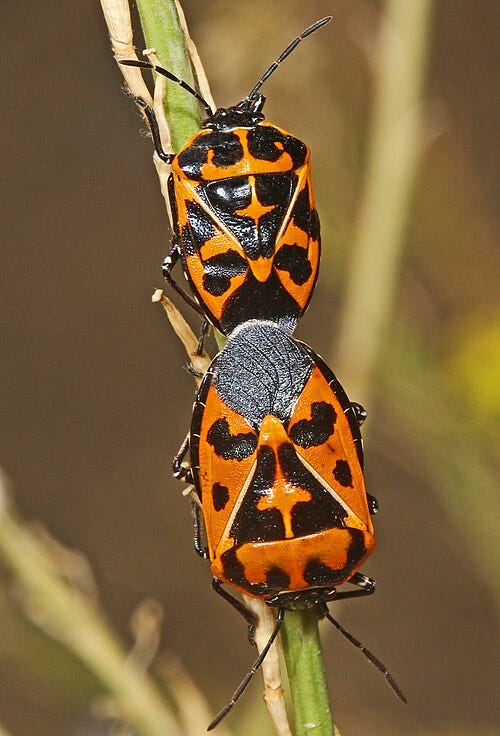
I got back from a short trip to find that my careful extermination of harlequin bugs prior to the trip had not worked: there were a lot of them on the cabbages, collards, and cauliflower plants. These bugs reproduce very quickly. A female harlequin bug can lay hundreds of eggs in one season. They mate repeatedly, which you may have noticed: they always seem to be doing something weird back to back like this:
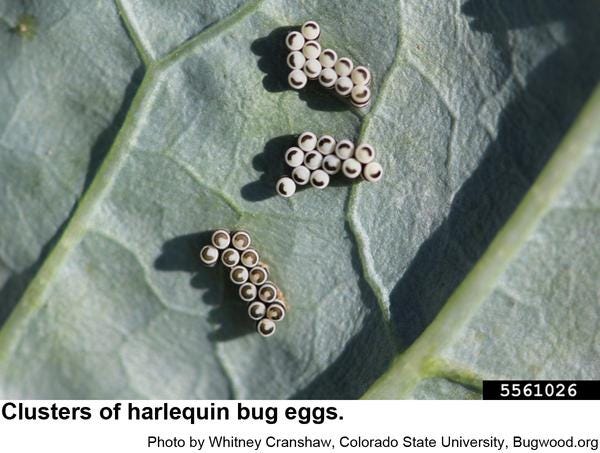
Apparently female harlequin bugs have a storage area called the spermatheca, where they store the sperm that fertilizes their eggs. Then they lay about twelve eggs every three days. The eggs look like tiny black and white barrels very close together.
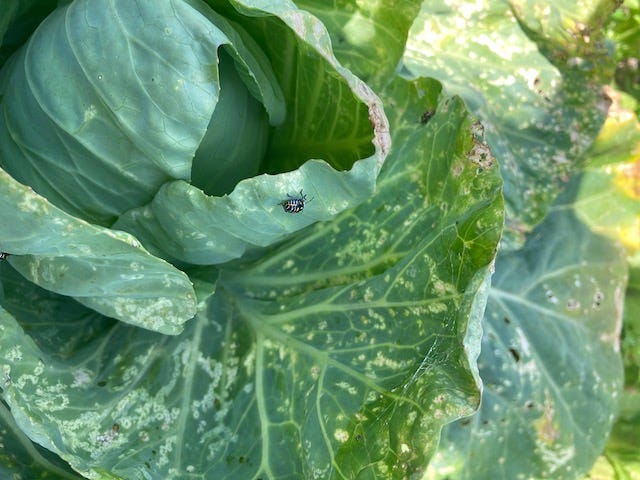
But the first thing you will probably see is the damage from the adults feeding. It looks like white or dead spots on the leaves:
Before I left for my trip, I sprayed some Pyganic, a pyrethrin spray, on the plants. This sort of knocked them back a little and may have killed a few of the nymphs, but it doesn’t kill the adults, and I knew that. I also hand-picked some of the adults off and squashed them. Birds don’t eat them because apparently they taste bad.
Probably the easiest way to get rid of them is to go out early in the morning before they start moving around a lot, when it’s still cool. You can take a container of soapy water and just drop them in it. They are not that hard to catch; their main strategy seems to be to simply let go of the leaf and fall. Some of them get away that way, and some fall right into the soapy water if you hold the container right. Scrape the eggs off into the soapy water too, or simply remove the leaf with the eggs on it. (They don’t crush easily.)
Another approach, when you don’t want to spend time searching for them, is to cover the whole bed with Proteknet. I have Proteknet on some eggplants right now, and it is keeping the flea beetles off them for the first time ever in my history of trying to grow eggplants! Of course I’ll have to take it off when they flower, but by then they’ll be big enough to shrug off the flea beetles. With brassicas, though, you don’t care about pollination usually, so the Proteknet could stay on all season. Some lightweight Agribon would work too, but the Proteknet is see-through and so it’s easier to see if weeds are taking over under it. I found it in smaller lengths at Fedco. Johnny’s sells it too, but you have to buy 110 feet of it. Maybe it’s useful enough to do that!
(For the eggplant I draped the Proteknet over plastic hoops and secured it with clips.)(
That’s the bad news. The good news is that most of my purple vegetables are doing great. Not all of them are extremely productive, but they’re all pretty.
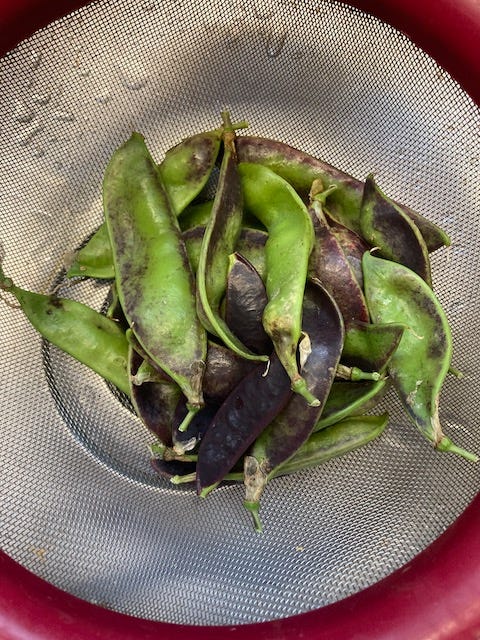
The ‘Royal Snow’ peas are very attractive. I sautéed some in toasted sesame oil and it was delicious. (First I removed the strings.) But they are not nearly as productive as my previous regular variety, ‘Oregon Giant,’ so I probably will not grow them again.
Some purple potatoes volunteered next to the pea row, and I dug some up today. I don’t know what variety they are because I got the original ones at a grocery store. But they were doing pretty well for volunteers. Presumably when I dug them last summer, I didn’t get them all, and so a few remained in the soil all winter and then sprouted this spring. I left them there, but did not fertilize them or anything. Surprisingly, they did pretty well. Here they are with some other volunteer ‘Kennebec’ and ‘Red Pontiac.’
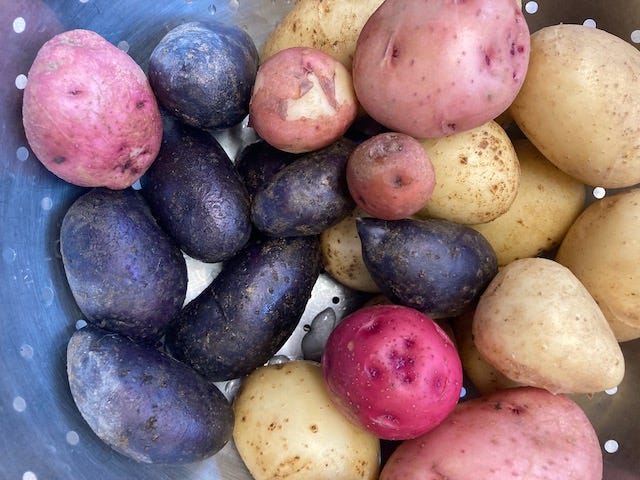
I planted some blue potatoes on purpose this spring called ‘Huckleberry Gold,’ but it’s too early to dig them up yet.
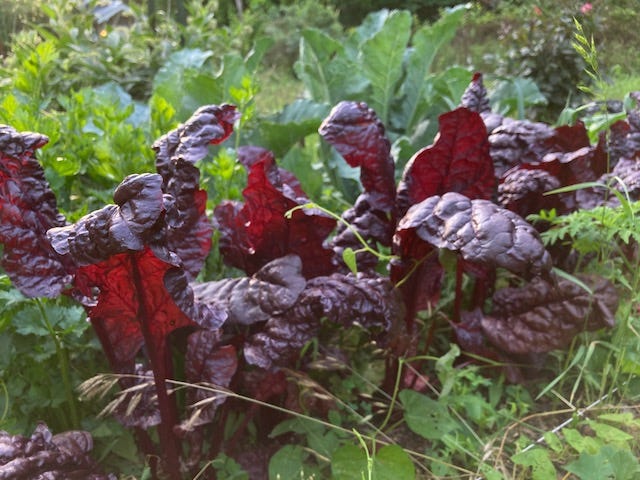
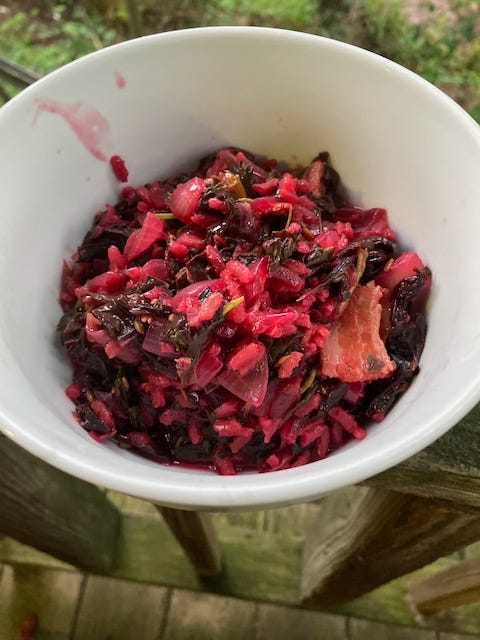
The purple chard, ‘Firebird,’ has been amazing. It looks great, and it tastes very good when cooked for about twenty minutes. (Chard needs some time cooking, I have found, even though a lot of recipes tell you to just quickly sauté it in olive oil. I think it tastes better after it’s had some time mellow out a little with onion and some olive oil or bacon grease.) This variety hasn’t been attacked by insects to the degree that “regular” chard is. Usually by this time of year, there are a lot of holes in the chard and black areas on the stems, but bugs don’t seem to like the ‘Firebird’ chard as much. In the late afternoon the leaves just glow. It would look great in a green salad with lettuce, but I don’t really like raw chard.
It stays bright red when you cook it. I cooked it with some bacon and onion:
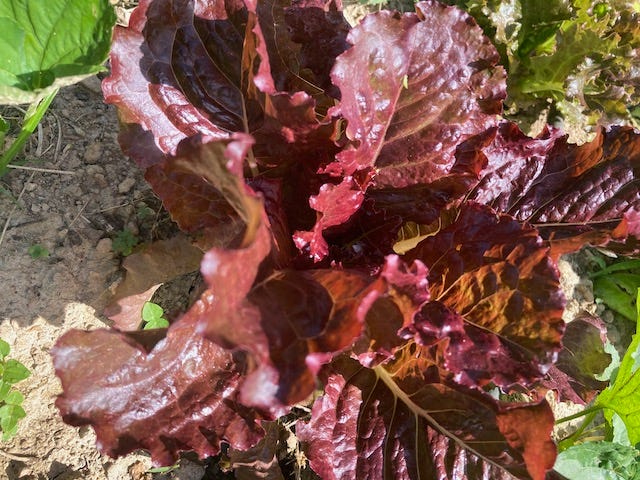
For a red color in a salad, I would go with this lettuce, ‘New Red Fire.’ There are lots of red lettuces to choose from, but this one is supposed to be heat tolerant.
The most surprising purple crop this summer has been the cauliflower. I planted two kinds, ‘Amethyst’ and ‘Murasaki Fioretto 70.’ They look pretty similar, but ‘Amethyst’ may have a more saturated color.
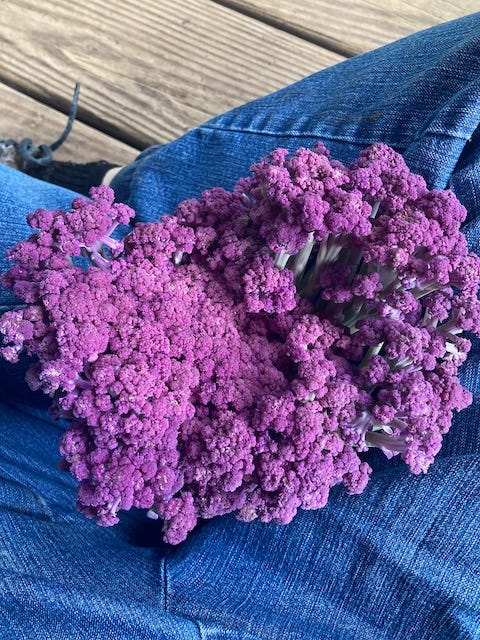
I thought it would be hard to grow cauliflower, but it really wasn’t. The plants are big like broccoli plants, and in their time, they make a head just like broccoli. I did coddle the seedlings a little in the sense that I never let them get very cold. They have to stay over 50 degrees fahrenheit, so you can’t just put them out on the porch and leave them there on a cold night in the early spring. Otherwise they might “button,” meaning they might make a small head.
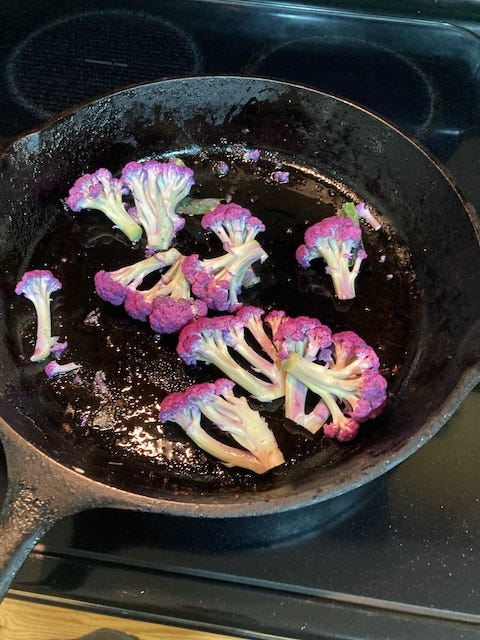
That didn’t happen: the heads are about six inches in diameter at least. They don’t like hot weather, so now that it is getting a bit hot I am harvesting a lot of them. So far I have cooked them very simply: either steamed them in a steamer basket over boiling water or sautéed them in olive oil or butter. The color stays good if you cook them quickly.
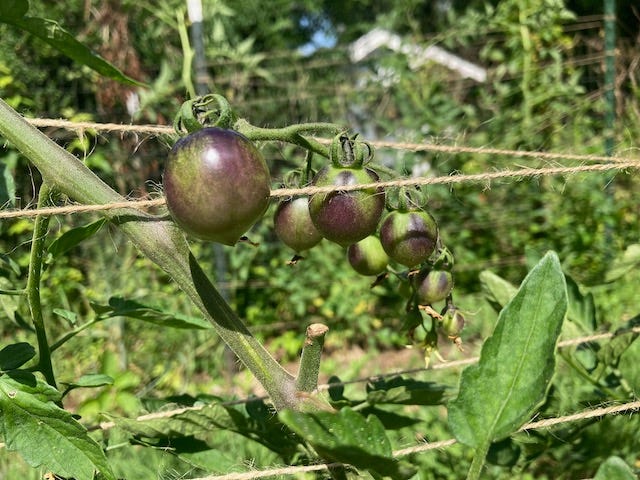
The ‘Indigo Cherry Drops’ tomatoes are coming along too, but are not ready to harvest. The plants seem to need more support than the other cherry tomatoes I have grown. They are doing better supported by stakes and strings than in the cages, where they tend to droop onto the ground. I think they have potential.
Eggplants are always purple, but they too are not ready yet, nor are the purple peppers. I will report back on those later in the summer.
What a variety! You are a hardworking gardener!